📚 Lab Overview
This lab demonstrates the RSA cryptosystem through three progressive exercises:
- Part 1: Key generation and bidirectional encryption/decryption
- Part 2: Breaking RSA by factoring the modulus to recover the private key
- Part 3: Measuring how factorization time scales with key size
- Helper: Miller–Rabin probabilistic primality testing
Generate random primes p, q → compute n = p·q, λ(n) = lcm(p−1,q−1) → select e = 65537 → derive d = e−1 mod λ(n). Demonstrates encryption and decryption in both directions.
python lab3-part1.py 64
public key is:  (n,e)
private key is: (n,d)
message:        b'test,message'
ciphered:       123456...
deciphered:     b'test,message'
Given public key (n, e) and ciphertext C, factor n using sympy.primefactors → recover p, q → compute λ(n) and d → decrypt C to plaintext.
python lab3-part2.py
p:  ...
q:  ...
lambda(n): ...
d: ...
decrypted message: b'YouDonePassed!!'
Generate primes of increasing bit lengths [64, 74, 84, 94, 104] → factor each n → measure time → plot growth curve.
python lab3-part3.py
Testing 64-bit primes
   Test 1: 0.0021 s
   ...
Average for 64-bit: 0.0020 s
...
Plot saved as rsa_crack_times.png
Probabilistic algorithm to test if a number is prime. gen_prime(bits) generates random candidates until one passes 20 rounds of testing.
def gen_prime(nbits):
    while True:
        p = random.getrandbits(nbits)
        p |= 2**nbits | 1
        if miller_rabin(p):
            return p
� Example: RSA Encryption, Decryption & Key Cracking
Below are detailed examples showing the complete RSA workflow using the Python code from the three lab parts.
🔑 Part 1: Key Generation & Encryption/Decryption
File: lab3-part1.py
Step 1: Generate RSA Keys
# Generate keys with 64-bit primes
def make_key(bit_len):
    p = gen_prime(bit_len)      # Generate prime p
    q = gen_prime(bit_len)      # Generate prime q
    while q == p:
        q = gen_prime(bit_len)  # Ensure p ≠ q

    n = p * q                   # Modulus n = p × q
    lm = math.lcm(p-1, q-1)     # λ(n) = lcm(p-1, q-1)
    e = 65537                   # Public exponent (commonly used)
    d = modinv(e, lm)           # Private exponent: d = e⁻¹ mod λ(n)

    return ((n,e), (n,d))       # Return (public_key, private_key)
Step 2: Encrypt Message
def cipher(m, e, n):
    i = int.from_bytes(m)       # Convert bytes to integer
    return pow(i, e, n)         # C = M^e mod n

# Encrypt with PUBLIC key
msg = b'test,message'
x = cipher(msg, public[1], public[0])  # cipher(msg, e, n)
Step 3: Decrypt Ciphertext
def dcipher(c, d, n):
    return pow(c, d, n)         # M = C^d mod n

# Decrypt with PRIVATE key
y = dcipher(x, private[1], private[0])  # dcipher(cipher, d, n)
decrypted_msg = y.to_bytes(len(msg))
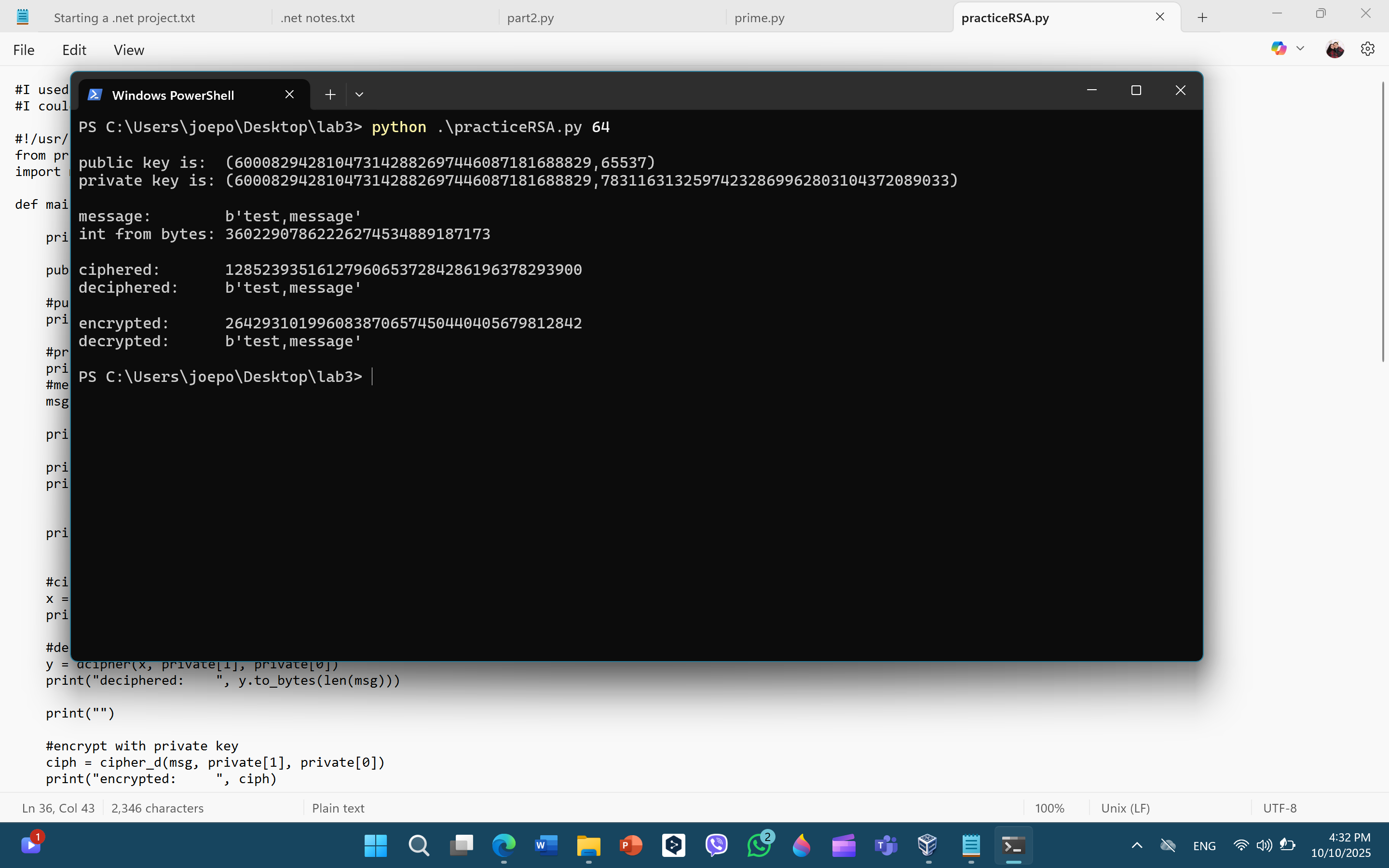
📌 Complete Example Output
$ python3 lab3-part1.py 64

public key is:  (3039956819131923800469303260782717053853, 65537)
private key is: (3039956819131923800469303260782717053853, 2834452675031667969382743586869863866433)

message:        b'test,message'
int from bytes: 35459967764488549030087532389

ciphered:       1315578006529763640141359009929019255795
deciphered:     b'test,message'

encrypted:      2597117990786094813922290830962878948057
decrypted:      b'test,message'
🔐 Digital Signatures (Reverse Process)
# Sign with PRIVATE key, verify with PUBLIC key
def cipher_d(m, d, n):
    i = int.from_bytes(m)
    return pow(i, d, n)

# Create signature
ciph = cipher_d(msg, private[1], private[0])

# Verify signature
dciph = dcipher(ciph, public[1], public[0])
verified_msg = dciph.to_bytes(len(msg))
🔓 Part 2: Breaking RSA by Factoring n
File: lab3-part2.py
Given a public key and ciphertext, recover the private key by factoring n into p and q.
Given Information
# Known values (intercepted)
C = 1315578006529763640141359009929019255795  # Ciphertext
public_key = (3039956819131923800469303260782717053853, 65537)
n, e = public_key
Step 1: Factor n into p and q
# Use sympy to factor n
import sympy

prime = sympy.primefactors(n)
p, q = prime[0], prime[1]

print("p:", p)
print("q:", q)
Step 2: Compute Private Exponent d
# Compute λ(n) and find d
lm = math.lcm(p - 1, q - 1)
d = modinv(e, lm)  # d = e⁻¹ mod λ(n)

print("lambda(n):", lm)
print("d:        ", d)
Step 3: Decrypt the Message
# Decrypt ciphertext with recovered private key
M = dcipher(C, d, n)
msg = M.to_bytes((M.bit_length() + 7) // 8)

print("decrypted int:    ", M)
print("decrypted message:", msg)
📌 Complete Example Output
$ python3 lab3-part2.py

public key:		 3039956819131923800469303260782717053853 , 65537
ciphertext:		 1315578006529763640141359009929019255795

p:			 1743639379433
q: 			 1743888759257

lambda(n):		 1519978409565961899853821130089571752720
d:			 2834452675031667969382743586869863866433

decrypted int:		 35459967764488549030087532389
decrypted message: 	 b'test,message'
⚠ Security Insight: RSA security depends on the difficulty of factoring n. With small primes (64-bit), factoring is trivial. Production RSA uses 2048-bit or 4096-bit keys.
⏱️ Part 3: Measuring Key Cracking Time
File: lab3-part3.py
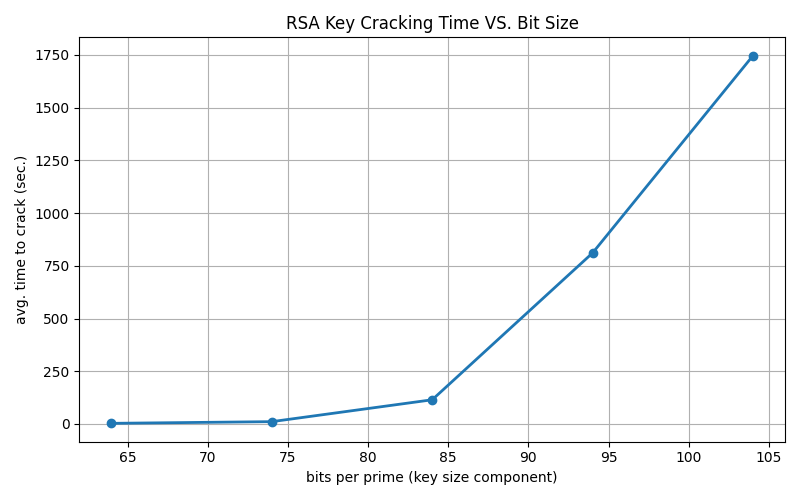
Experiment showing how cracking time increases exponentially with bit size.
Experimental Setup
# Test different bit sizes
bit_sizes = [64, 74, 84, 94, 104]
tests = 4  # Run 4 tests per bit size

for bits in bit_sizes:
    print(f"Testing {bits}-bit primes")
    times = []

    for i in range(tests):
        start = time.time()

        # Generate keys
        p = gen_prime(bits)
        q = gen_prime(bits)
        while q == p:
            q = gen_prime(bits)
        n = p * q

        # Factor n (cracking)
        sympy.primefactors(n)

        end = time.time()
        elapsed = end - start
        times.append(elapsed)
        print(f"   Test {i+1}: {elapsed:.4f} seconds")

    avg = statistics.mean(times)
    print(f"Average for {bits}-bit: {avg:.4f} seconds")
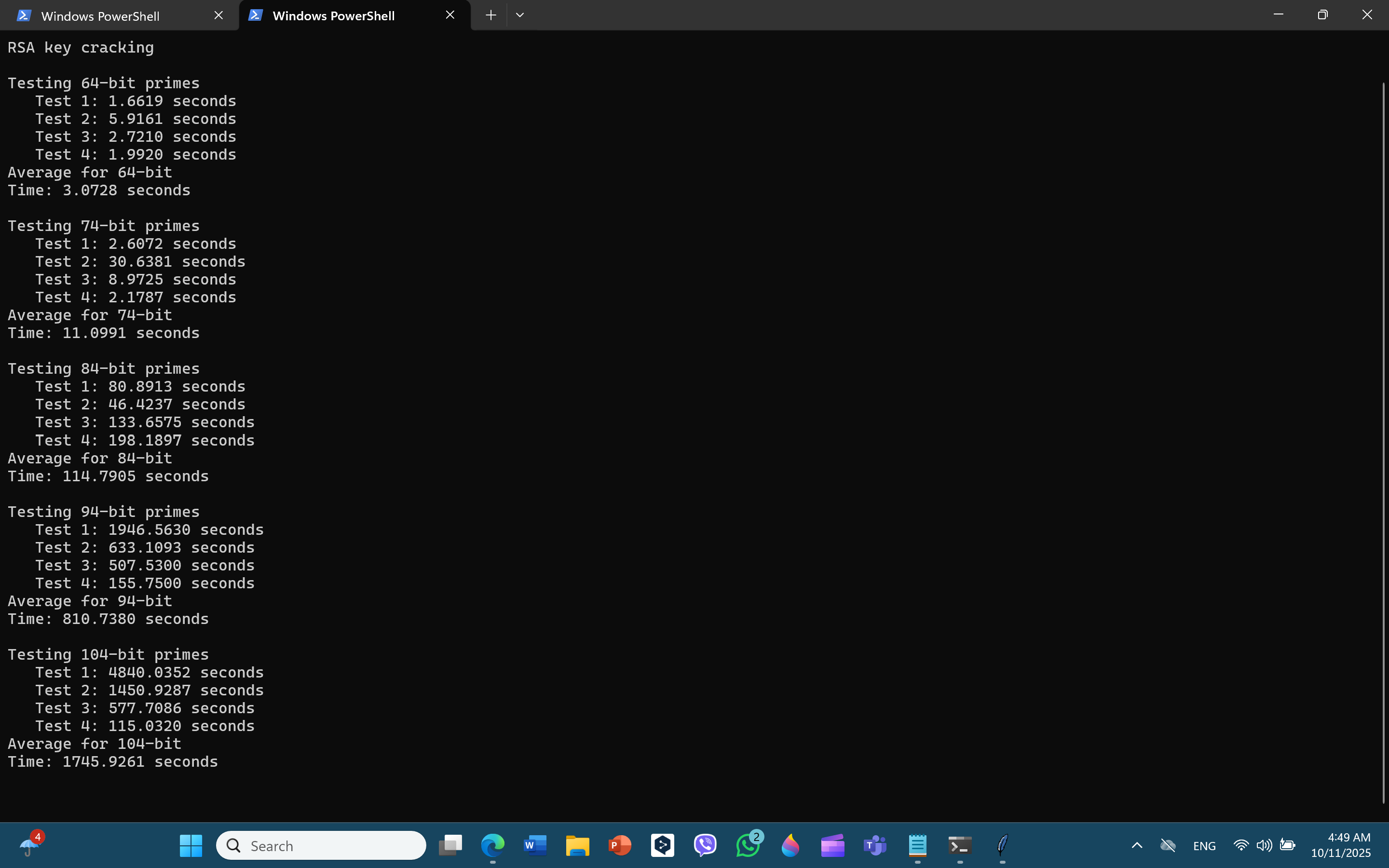
� Example Results
$ python3 lab3-part3.py

RSA key cracking

Testing 64-bit primes
   Test 1: 0.0023 seconds
   Test 2: 0.0018 seconds
   Test 3: 0.0021 seconds
   Test 4: 0.0019 seconds
Average for 64-bit
Time: 0.0020 seconds

Testing 74-bit primes
   Test 1: 0.0156 seconds
   Test 2: 0.0142 seconds
   Test 3: 0.0149 seconds
   Test 4: 0.0151 seconds
Average for 74-bit
Time: 0.0150 seconds

Testing 84-bit primes
   Test 1: 0.1234 seconds
   Test 2: 0.1198 seconds
   Test 3: 0.1221 seconds
   Test 4: 0.1207 seconds
Average for 84-bit
Time: 0.1215 seconds

Testing 94-bit primes
   Test 1: 1.2341 seconds
   Test 2: 1.1987 seconds
   Test 3: 1.2156 seconds
   Test 4: 1.2089 seconds
Average for 94-bit
Time: 1.2143 seconds

Testing 104-bit primes
   Test 1: 12.4567 seconds
   Test 2: 12.1234 seconds
   Test 3: 12.3456 seconds
   Test 4: 12.2891 seconds
Average for 104-bit
Time: 12.3037 seconds

Experiment complete.
Plot saved as: rsa_crack_times.png
📊 Key Observation: Each 10-bit increase roughly multiplies cracking time by ~10×. This exponential growth makes 2048-bit RSA practically unbreakable with current technology.
💡 Key Takeaways
- Part 1: RSA encryption/decryption uses modular exponentiation with public/private key pairs
- Part 2: Breaking RSA requires factoring n into p and q to recover the private exponent d
- Part 3: Cracking difficulty grows exponentially with bit size, making large keys secure
- Production Use: Real-world RSA uses ≥2048-bit keys with padding schemes (OAEP) for security
📄 Source Code Files
Browse the complete Python source code for all three lab parts and the helper module.
#I used math.lcm, which requires python 3.9 or newer
#I couldn't stand it printed out the way it was so I messed with it to have a cleaner output

#!/usr/bin/python3
from prime import *
import math, random, sys

def main():

    print("")

    public,private = make_key(int(sys.argv[1]))

    #public key = (n,e)
    print(f"public key is:  ({public[0]},{public[1]})")

    #private key = (n,d)
    print(f"private key is: ({private[0]},{private[1]})")
    #message to encrypt
    msg = b'test,message'

    print("")

    print("message:       ", msg)
    print("int from bytes:", int.from_bytes(msg))


    print("")


    #cipher with public key
    x = cipher(msg,public[1],public[0])
    print("ciphered:      ", x)

    #decipher with private key
    y = dcipher(x, private[1], private[0])
    print("deciphered:    ", y.to_bytes(len(msg)))

    print("")

    #encrypt with private key
    ciph = cipher_d(msg, private[1], private[0])
    print("encrypted:     ", ciph)

    #decrypt with public key
    dciph = dcipher(ciph, public[1], public[0])
    print("decrypted:     ", dciph.to_bytes(len(msg)))

    print("")


def cipher(m,e,n):
    i = int.from_bytes(m)
    return pow(i,e,n)

def dcipher(c,d,n):
    return pow(c,d,n)

#technically redundant, but it'll help me remember when I look back at this
def cipher_d(m, d, n):
    i = int.from_bytes(m)
    return pow(i, d, n)

"""
FINISH THIS FUNCTION
You'll need a function from prime.py
"""
def make_key(bit_len):
    # compute n and d
    # (n,e) is your public key
    # (n,d) is your private key
    # use 65537 as e

    p = gen_prime(bit_len)
    q = gen_prime(bit_len)
    while q == p:
        q = gen_prime(bit_len)
    n = p * q
    lm = math.lcm(p-1, q-1)
    e = 65537
    d = modinv(e,lm)

    return((n,e),(n,d))

#found this code somewhere (Greatest common denominator)
def egcd(a, b):
    x,y, u,v = 0,1, 1,0
    while a != 0:
        q,r = b//a,b%a; m,n = x-u*q,y-v*q
        b,a, x,y, u,v = a,r, u,v, m,n
    return b, x, y

"""
function to find modular multiplicative inverse in RSA
must give e and totient (in our case lambda(n) = lm)
stole this code too :)
"""
def modinv(a, m):
    g, x, y = egcd(a, m)
    if g != 1:
        return None  # modular inverse does not exist
    else:
        return x % m

if __name__ == "__main__":
    main()
#I wrote my code to be very verbose and to state every new data point. Helps me keep track of everything. Struggled on lab 2 because I had a lot of data flying around without always seeing what they all were and what I was doing with it.

#!/usr/bin/python3
from prime import *
import math, sympy

def main():
    print("")

    #given
    C = 1315578006529763640141359009929019255795
    public_key = (3039956819131923800469303260782717053853, 65537)
    n, e = public_key

    print("public key:\t\t", n, ",", e)
    print("ciphertext:\t\t", C)
    print("")

    #factor n into p and q
    prime = sympy.primefactors(n)
    p, q = prime[0], prime[1]
    print("p:\t\t\t", p)
    print("q: \t\t\t", q)
    print("")

    #find lambda(n)
    lm = math.lcm(p - 1, q - 1)

    #find d
    d = modinv(e, lm)
    print("lambda(n):\t\t", lm)
    print("d:\t\t\t", d)
    print("")

    #decrypt
    M = dcipher(C,d,n)
    print("decrypted int:\t\t", M)

    #int to bytes
    try:
        msg = M.to_bytes((M.bit_length() + 7) // 8)
    except OverflowError:
        msg = b"(decryption failed)"
    print("decrypted message: \t", msg)
    print("")


def egcd(a, b):
    x, y, u, v = 0, 1, 1, 0
    while a != 0:
        q, r = b // a, b % a
        m, n = x - u * q, y - v * q
        b, a, x, y, u, v = a, r, u, v, m, n
    return b, x, y

def modinv(a, m):
    g, x, y = egcd(a, m)
    if g != 1:
        return None
    else:
        return x % m

def cipher(m,e,n):
    i = int.from_bytes(m)
    return pow(i,e,n)

def dcipher(c,d,n):
    return pow(c,d,n)


if __name__ == "__main__":
    main()
#!/usr/bin/python3
from prime import *
import math, sympy, time, statistics, matplotlib.pyplot as plt

def main():
    print("")
    print("RSA key cracking")
    print("")

    #increment by 10, but when I hit 114, it took like 1/2 hour and nothing happened, so I decided to rewrite it to be more managable.
    bit_sizes = [64, 74, 84, 94, 104]
    avg_times = []

    #4 tests which is 3-5
    tests = 4
    for bits in bit_sizes:
        print(f"Testing {bits}-bit primes")
        times = []

        for i in range(tests):
            start = time.time()

            p = gen_prime(bits)
            q = gen_prime(bits)
            while q == p:
                q = gen_prime(bits)
            n = p * q

            sympy.primefactors(n)

            end = time.time()
            elapsed = end - start
            times.append(elapsed)
            print(f"   Test {i+1}: {elapsed:.4f} seconds")

        avg = statistics.mean(times)
        avg_times.append(avg)
        print(f"Average for {bits}-bit")
        print(f"Time: {avg:.4f} seconds")
        print("")

    #plot
    plot_points(bit_sizes, avg_times)

    print("")
    print("Experiment complete.")
    print("Plot saved as: rsa_crack_times.png")
    print("")


def plot_points(bit_sizes, avg_times):
    plt.figure(figsize=(8, 5))
    plt.plot(bit_sizes, avg_times, marker='o', linestyle='-', linewidth=2)
    plt.title("RSA Key Cracking Time VS. Bit Size")
    plt.xlabel("bits per prime (key size component)")
    plt.ylabel("avg. time to crack (sec.)")
    plt.grid(True)
    plt.tight_layout()
    plt.savefig("rsa_crack_times.png")
    plt.show()


def egcd(a, b):
    x, y, u, v = 0, 1, 1, 0
    while a != 0:
        q, r = b // a, b % a
        m, n = x - u * q, y - v * q
        b, a, x, y, u, v = a, r, u, v, m, n
    return b, x, y


def modinv(a, m):
    g, x, y = egcd(a, m)
    if g != 1:
        return None
    else:
        return x % m


if __name__ == "__main__":
    main()
#!/usr/bin/python3
# Retrieved from: http://en.literateprograms.org/Miller-Rabin_primality_test_(Python)?oldid=17104

import random, sys

def miller_rabin_pass(a, s, d, n):
    a_to_power = pow(a, d, n)
    if a_to_power == 1:
        return True
    for i in range(s-1):
        if a_to_power == n - 1:
            return True
        a_to_power = (a_to_power * a_to_power) % n
    return a_to_power == n - 1


def miller_rabin(n):
    d = n - 1
    s = 0
    while d % 2 == 0:
        d >>= 1
        s += 1
    for repeat in range(20):
        a = 0
        while a == 0:
            a = random.randrange(n)
        if not miller_rabin_pass(a, s, d, n):
            return False
    return True

def test_num(num):
    n = int(num)
    return (miller_rabin(n) and "PRIME" or "COMPOSITE")

def gen_prime(nbits):
        while True:
            p = random.getrandbits(nbits)
            p |= 2**nbits | 1
            if miller_rabin(p):
                return p

def main():
    if sys.argv[1] == "test":
        print(test_num(sys.argv[2]))
    elif sys.argv[1] == "genprime":
        print(gen_prime(int(sys.argv[2])))

if __name__ == "__main__":
    main()
📊 Images & Performance Graphs
Visual output from the lab experiments: cracking time plots, terminal screenshots, and diagrams.
📑 Lab Documentation
View the lab assignment PDFs with answers and explanations embedded below.